
Nelson Mandela, in his 1994 autobiography, Long Walk to Freedom, stated that
“No one is born hating another person because of the colour of his skin, or his background, or his religion. People must learn to hate, and if they can learn to hate, they can be taught to love, for love comes more naturally to the human heart than its opposite.”
Since my father’s passing in 2024, my life has been mostly reflective, and a major part of my reflections have been on the kind of change I want to see and how that translates into the work I do in human rights.
Evidently, the University of Oxford’s MSc IHRL programme afforded me the opportunities to expand the scope of my knowledge of human rights law and practice by doing and learning more.
Making optimum use of the opportunities at Oxford, I began by challenging myself to learn subjects that I had not directly tackled in my human rights career. One of such subjects was on the rights to freedom of religion and belief (FORB). A challenging but necessary subject. I needed to understand the rights to freedom of thought, conscience, religion, belief, and expression and how that relates to peacebuilding, conflict resolution, equality, discrimination, and criminal justice.
What a ride it has been!
In the past year, thanks to partnerships with organisations like MISEREOR in Nigeria, Concord Initiative, and the Catholic Secretariat. My work on promoting inter-faith dialogue, religious rights, and conflict resolution has deepened. I consider myself privileged to have sat in rooms with religious leaders, traditional leaders, and CSOs across the country to facilitate and moderate sessions on peacebuilding and FORB.
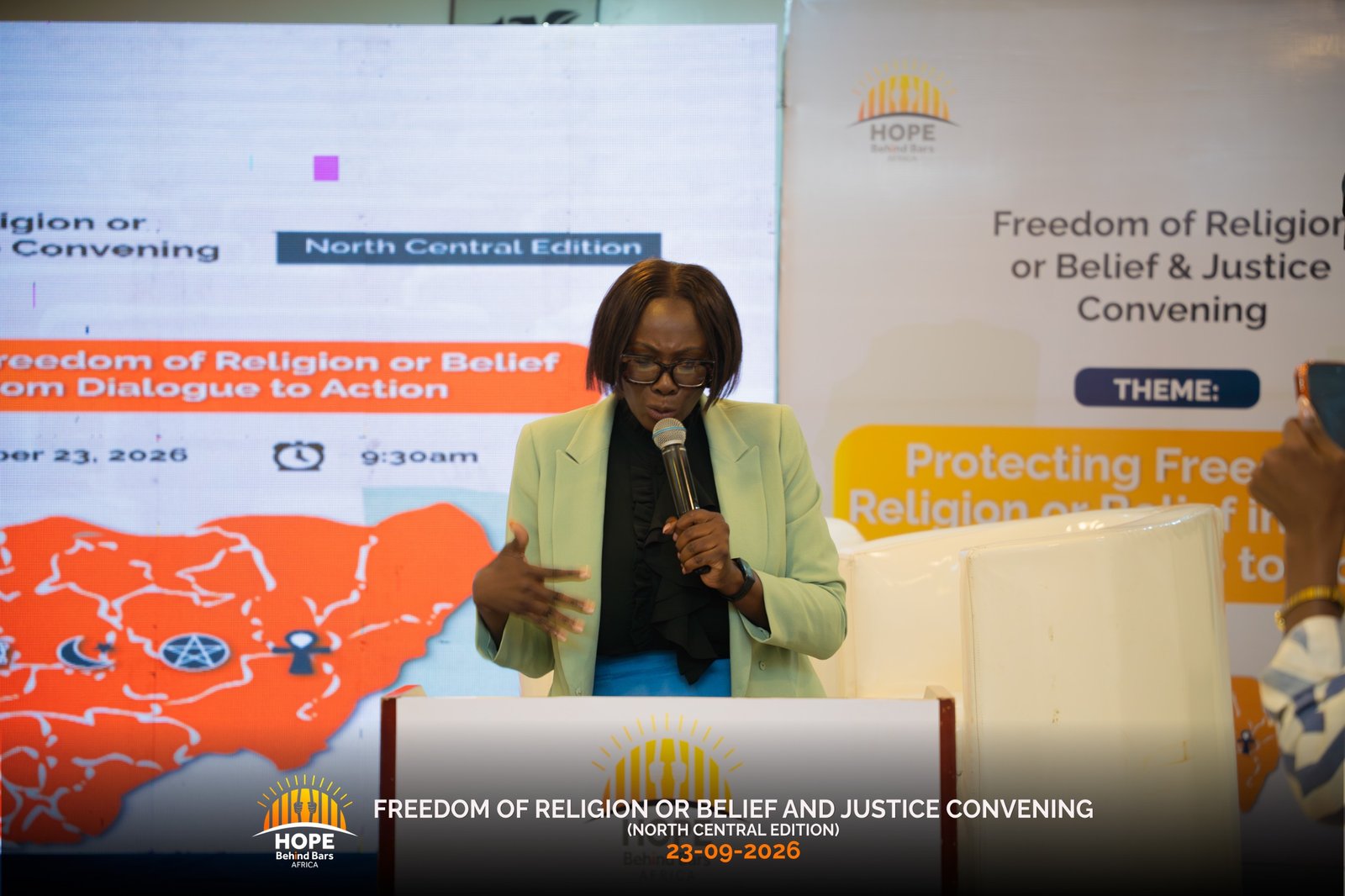
Recently, I delivered my first Keynote Paper at Hope Behind Bars Africa’s Regional Convening on the Right to Freedom of Religious Belief in Nigeria, titled Moving Beyond Tolerance to True Belonging by strengthening Freedom of Religion or Belief (FoRB) through rights-based criminal justice and equal citizenship in Nigeria.
Drawing on Nelson Mandela and Timothy Keller’s writing, I emphasise prejudice as a learned, systemised behaviour, arguing that true tolerance requires defending human dignity even when disagreeing with others’ beliefs. Distinguishing tolerance from belonging, the paper argues that tolerance is often passive, conditional, and treated as a concession by dominant groups. Belonging, on the other hand, represents genuine connection, mutual respect, and valuing others for who they are. As human beings, we must move from tolerance to belonging, because true constitutional democracy demands equal citizenship and mutual respect, not mere endurance.
FoRB transcends the realm of a persuasive right. Grounded in global and regional instruments, it is a right that must be protected for all citizens. The 1999 Constitution, as amended, guarantees the freedom to profess a religion or belief, freedom to change one’s religion or belief, the freedom to criticise any religion or belief, and freedom to profess no religion or belief are indicative of a civilised society. These rights necessitate the evolution of a true and virile democracy. The FoRB right is intrinsically linked with the rights to freedom of expression, freedom of association, and other civil and political rights. Consequently, no country can lay claim to promoting and protecting human rights without guaranteeing the freedom of religion or belief of all its people.
Nigerian society struggles with intolerance based on religious beliefs. The Nigerian reality is that a dangerous gap exists between constitutional rights on paper and protection in practice. The problems are manifested as social and political pressure, religious tensions, discrimination against minorities, and the friction between equal citizenship and indigeneity. The Nigerian reality includes insulting or mocking another person’s beliefs, the deprivation of opportunities for people of minority religious groups, and intentional speech focused on inciting violence. It is noteworthy that arrests and convictions under blasphemy laws also fall within the ambit of intolerance. Religious intolerance not only manifests itself in clear actions, but also in deeply rooted behavioural structures such as avoiding individuals based on how they look, how they dress, and their names. These discriminatory practices result in unequal treatment of others based on their beliefs.
Nigeria needs to step up in its obligations and responsibilities when it comes to human rights and FoRB protections. We need institutional and legislative reforms that eliminate indirect discrimination, protect minority expression, and push back against the weaponisation of vague laws on blasphemy or public disturbance. Our criminal justice and law enforcement architecture must ensure due process, protect against mob justice, and train law enforcement to impartially investigate and prosecute religion-based violence.
National unity is critical to protecting Nigeria’s diversity. Achieving this requires action over rhetoric: systemic reform, equal protection, and an unwavering commitment to the rule of law. These are the binding elements that hold a multi-faith democracy together.
As Scott Howard Phillips said, “You can’t pick and choose which types of freedom you want to defend. You must defend all of it or be against all of it.”