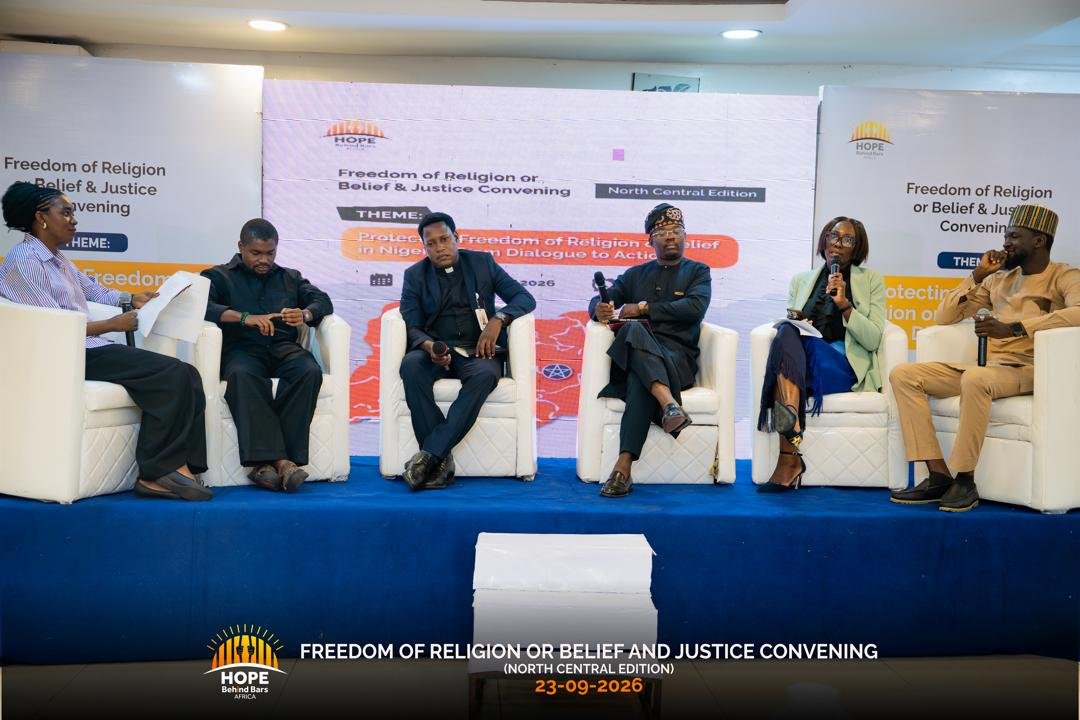
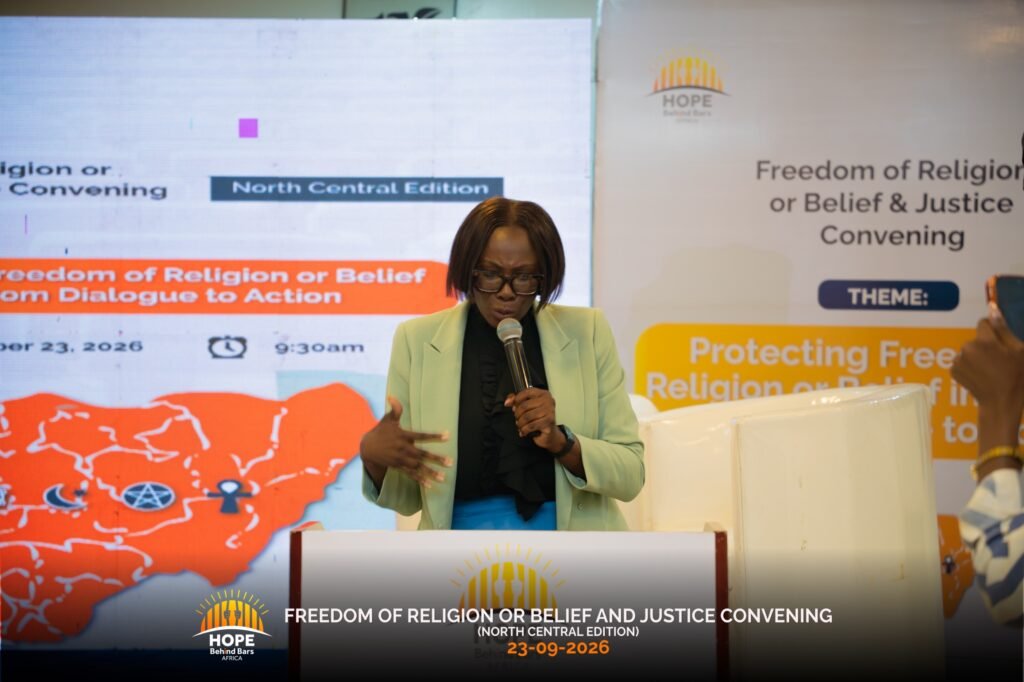
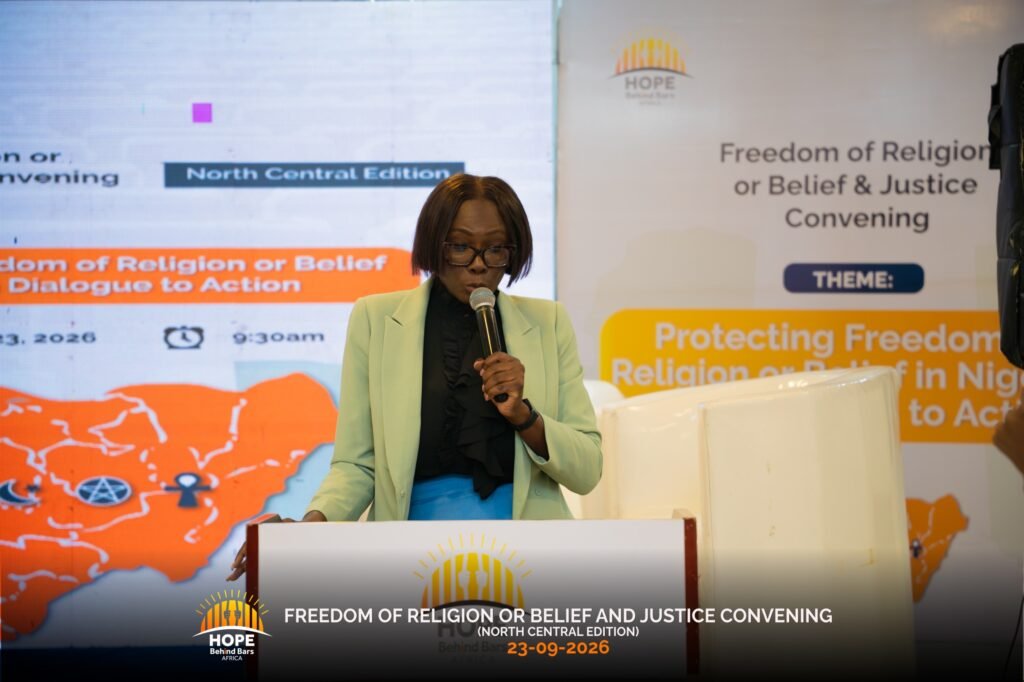
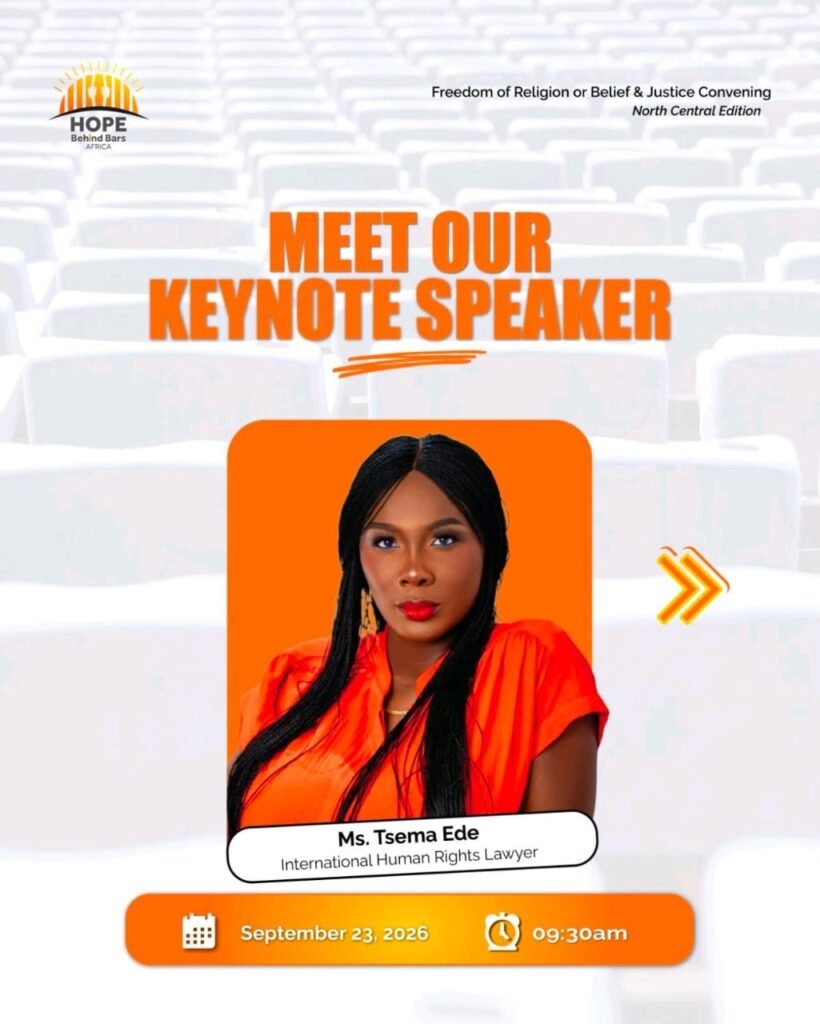
Theme: Beyond Tolerance: Strengthening Freedom of Religion or Belief through Rights-Based Criminal Justice and Equal Citizenship in Nigeria
Presented at a Regional Convening on the Right to Freedom of Religious Belief in Nigeria
Date: Wednesday, the 23rd of September 2026
Good morning, ladies and gentlemen, standing on existing protocol. I begin with a quote.
“No one is born hating another person because of the colour of his skin, or his background, or his religion. People must learn to hate, and if they can learn to hate, they can be taught to love, for love comes more naturally to the human heart than its opposite.”
― Nelson Mandela.
This famous reflection comes from Nelson Mandela’s 1994 autobiography, Long Walk to Freedom. Mandela observed that children of different races naturally play and live together harmoniously, proving that prejudice is not an innate human trait, but a systemised behaviour taught by society and political regimes. He genuinely believed, and I do too, that human beings, even those who taught or practised hate, remained capable of unlearning it and choosing empathy instead. I believe that this quote lays a foundation for our conversation on Beyond Tolerance: strengthening Freedom of Religion or Belief through rights-based criminal justice and equal citizenship in Nigeria.
I ask: why are we here?
With Africa being a deeply religious society, the exercise of freedom of religion or belief (FoRB) and related discourse is sensitive across the region. Nigeria is no exception. I believe that a problem exists when it comes to religious tolerance in Nigeria. Tolerance is often passive and conditional: “we tolerate you” because XYZ (act the way we want, speak the way we want, and maybe we can allow you to coexist with us). This is why we must move from Tolerance to Belonging. Tolerance, often defined as the willingness to accept and respect beliefs, behaviours, or differences that you may not agree with. Some may argue that tolerance implies a concession, where a dominant group “tolerates” a minority.
Timothy Keller once said that “Tolerance isn’t about not having beliefs. It’s about how your beliefs lead you to treat people who disagree with you.” For Keller, true tolerance is the difficult civic virtue of disapproving of an idea while fiercely defending the human dignity and rights of the person expressing it.
This is why we must move from tolerance to belonging. Belonging, on the other hand, is the feeling of being embraced and valued for exactly who you are, whereas tolerance is merely enduring or permitting someone’s presence without truly accepting them. While tolerance stops at coexistence, belonging requires genuine connection and mutual respect. True constitutional democracy demands equal citizenship and mutual respect, not mere endurance.
International Foundations of FoRB
An effective means to evaluate the extent of this guarantee is to examine the broader body of the legal framework for FoRB rights in Nigeria. The relevant legislation worthy of consideration in this regard includes the following: The Constitution of the Federal Republic of Nigeria 1999 (as amended), the Child Rights Act 2003, and the African Charter on Human and Peoples’ Rights (Ratification and Enforcement) Act, the Universal Declaration of Human Rights, 1948, the International Covenant for Civil and Political Rights.
Article 18 of the Universal Declaration of Human Rights (the UDHR is the core document for rights, globally) provides that everyone has the right to freedom of thought, conscience and religion; this right includes freedom to change his religion or belief, and freedom, either alone or in community with others and in public or private, to manifest his religion or belief in teaching, practice, worship and observance. The importance of living free from violence, including violence based on religion, is set forth by the Universal Declaration of Human Rights. In relation to the freedom of opinion, Article 19 outlines the freedom to express ideas without interference. Article 16 outlines the right for men and women to marry and found a family. In relation to violence, Article 9 outlines that no one shall be subjected to arbitrary arrest. Article 7 states that everyone is equal before the law. Articles 3 and 5 also address that everyone has the right to life and that no one shall be subjected to inhuman or degrading treatment.
African Charter on Human and Peoples’ Rights guarantees every African the right to Freedom of conscience and to profess and freely practice their religion. Articles 2 & 8 prohibit discrimination on the grounds of religion, ensuring equal protection for diverse faiths, including minority and indigenous belief systems. It provides that no one may, subject to law and order, be subjected to measures restricting the exercise of these freedoms. In essence, Governments cannot force individuals to follow a specific religion or stop them from practising their chosen faith if it does not break public laws or disrupt order.
Article 1 of the International Covenant on Civil and Political Rights provides that all peoples have the right of self-determination. By virtue of that right, they freely determine their political status and freely pursue their economic, social and cultural development. Article 18 explicitly mentions the freedom of conscience and religion. Article 20 also reaffirms that ‘any advocacy of national, racial or religious hatred that constitutes incitement to discrimination, hostility or violence shall be prohibited by law’. Advocacy in this regard can be explained as an unambiguous, direct call for the audience to act in a certain way.
Nigeria’s signing on to and ratifying these covenants make them binding international commitments, not optional policy suggestions.
Domestic and Constitutional Legal Frameworks
Sec. 38 of the 1999 Constitution of the Federal Republic of Nigeria guarantees every citizen the right to freedom of thought, conscience, and religion. It asserts that everyone has a right to hold any religious belief or change their religion. It protects the rights to public and private practice of religion by asserting that every person can practice, teach, and share their faith alone or with others, in public or in private. It prohibits places of education from forcing people to take part in or attend any religious ceremony or observance if such instruction, ceremony or observance relates to a religion other than his own, or a religion not approved by his parent or guardian. Additionally, it allows a religious community or denomination to provide religious instruction for pupils of that community or denomination in any place of education maintained wholly by that community or denomination. Section 10 goes on to prohibit the federal or state governments from adopting any religion as an official state religion. Section 42 prohibits all kinds of discrimination. Thus, citizens are constitutionally free from discrimination and should not be treated differently or unfairly because of their religion or lack of religion. The prohibition of discrimination on the grounds of religion or place of origin lays the bedrock for equal citizenship.
Section 7 of the CRA provides that every child has a right to freedom of thought, conscience and religion. Parents and, where applicable, legal guardians shall provide guidance and direction in the exercise of these rights having regard to the evolving capacities and best interests of the child. This right shall be respected by all persons, bodies, institutions and authorities. It goes on to refer to respect for children’s rights to freedom of thought, conscience and religion in fostering, custody, guardianship, and adoption of children, emphasising its paramount consideration.
What is Freedom of Religion or Belief, Thought and Conscience?
Freedom to profess a religion or belief, freedom to change one’s religion or belief, the freedom to criticise any religion or belief, and freedom to profess no religion or belief are indicative of a civilised society and an imperative for the evolution of a true and virile democracy. It is inherently linked with freedom of expression, freedom of association, and other civil and political rights. No country can lay claim to promoting and protecting human rights without guaranteeing the freedom of religion or belief of all its people.
In Welsh v. United States (1971), the US Supreme Court laid the foundation for courts to determine that people can interpret and hold their beliefs with the strength of more traditional religious convictions. In Medical and Dental Practitioners Disciplinary Tribunal v Okonkwo (2001). The Supreme Court affirmed that the constitutional right to freedom of thought, conscience, and religion protects an individual’s choice to conduct their life based on personal religious convictions, without unlawful coercion. In ENHRI v. Nigeria, the Community Court of Justice of the Economic Community of West African States (ECOWAS) held that blasphemy laws in Nigeria violated the fundamental right to freedom of expression guaranteed under Article 9(2) of the African Charter on Human and Peoples’ Rights and Article 19 of the International Covenant on Civil and Political Rights.
What DOES THE FORB Right Mean?
- It serves as a protection for everyone, including believers, non-believers, and those with secular or atheistic beliefs.
- It protects your inner opinions, private beliefs, personal moral compass, and deeply held values without government interference.
- It allows you to choose any religion or no religion at all.
- It grants the freedom to change or abandon beliefs, and to manifest religion or belief individually or collectively, in public or in private.
- Thus, discrimination and punishment for abandoning or changing religious belief or a religion is an obvious offence against a constitutional right.
- It affirms the right to manifest and propagate religion in a proper and non-coercive manner.
- Forum Internum and Externum: Encompasses both the absolute internal freedom of conscience/belief (forum internum) and the external manifestation/practice of religion (forum externum).
What is the Nigerian Reality?
In many African states, individuals and groups are denied this basic human right. Intolerance, persecution or discrimination based on religion or belief is widespread. There is social and political pressure on individuals to be religious and to remain religious; otherwise, they will experience discrimination. Mechanisms to uphold and defend freedom of conscience and protect individuals who change their religions, or who criticise religions or renounce their religious beliefs, are weak or non-existent in most African states.
However, we must remember that Nigeria’s strength lies in its pluralism, but deep-seated religious tensions and communal violence threaten the essence of our existence. As observed from the foregoing, the problem is not a lack of constitutional, institutional, or legislative text, but the dangerous gap between rights on paper and protection in practice. The news is fraught with stories of people who are punished and/or discriminated against for their beliefs, or lack thereof.
Where intolerance based on religious beliefs varies from insulting or mocking another person’s beliefs to persons being deprived of opportunities because of religion, and intentional hate speech focused on inciting violence; even arrests and convictions using blasphemy laws fall within the ambit of intolerance. Intolerance not only manifests itself in clear actions, but also in deeply rooted behavioural structures such as avoiding individuals based on appearance, dress, or name. Religious intolerance often constitutes a form of discrimination, because they result in unequal treatment based on individuals’ beliefs.
Additionally, where one religion is perceived to receive more recognition or benefit than others, in the form of rules surrounding religious symbols in schools and grants for time off for religious observances, it can lead to lasting harm to cultural identity, social imbalance, and a weakened unity within a diverse society like Nigeria. Nigeria’s religious pluralism also means that the dominant religions of Christianity and Islam are not the only religions or belief systems to be respected and protected. This begs the question: How are people who practice African traditional religions, humanism, etc. treated? With equality, respect, and dignity, or are they discriminated against?
Equal Citizenship vs. Indigeneity
Too often, a Nigerian’s safety and rights are determined by where they live or which religion is dominant in that region, creating first- and second-class citizens. Constitutional rights do not change across state lines; thus, enforcing equal citizenship means that the state treats all believers and non-believers with the same dignity. Nigeria’s secularity means that the State must not be hostile toward any religion or belief system. A level playing field for all is secured when the state and its agents do not favour one religion over another.
Rights-Based Criminal Justice: Protecting Against Arbitrary Restriction
Thus, to secure Nigeria’s future, we must anchor FoRB in enforceable rights and ensure that our criminal justice system fiercely protects every citizen’s right to believe, change belief, or manifest belief without fear. The indivisibility and interdependence of rights mean that FoRB cannot be protected in isolation; it is deeply tied to freedom of expression, assembly, and equal protection under the law. FoRB is the adhesive that holds a multi-faith democracy together
Recommendations
- Nigeria must actively combat intolerance against persons based on religion or belief.
- It is imperative for us to create neutral mechanisms to address potential areas of tension between members of different religious communities.
- We cannot afford to be blind to the diversity of religions that exist in our country. Acknowledging the context of Nigerian society allows us to strengthen mechanisms that promote joint initiatives for dialogue and accountability when it comes to the broad forms of intolerance, negative stereotypes, and discrimination.
- Public institutions must promote equal treatment initiatives and combat indirect discrimination based on religion.
- There is an urgent need for a healthy and balanced legislative intervention in the area of religious freedom in Nigeria; there are many deaths and destructions, especially in the Northern part of Nigeria.
- Push back against the weaponisation of vague laws (such as public disturbance or blasphemy laws applied arbitrarily) to stifle minority expression or dissent.
- Ensure due process, the right to a fair trial, and protection against mob justice (lynching, extrajudicial violence fueled by religious fervour).
- Law enforcement agencies must be trained to recognise FoRB violations, investigate religious-based violence impartially, and prosecute perpetrators regardless of their social, political, or religious standing.
I end with a challenge to us all: from policymakers to civil society and justice sector actors, we must transition from rhetoric to systemic institutional reform because true security and national unity cannot be bombed or legislated into existence; they are cultivated through a strict adherence to the rule of law and equal protection.
“You can’t pick and choose which types of freedom you want to defend. You must defend all of it or be against all of it.”
― Scott Howard Phillips